 BookBright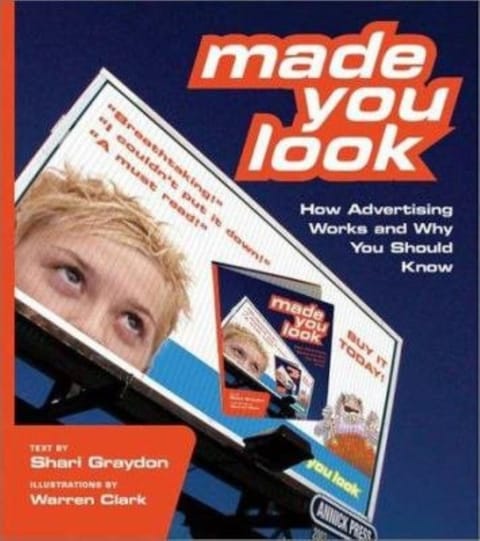
ABOUT THE BOOK
NO SPOILERSMade You Look: How Advertising Works and Why You Should Know is a nonfiction guide written for kids about the ads, commercials, and sales pitches most people never really think about. Author Shari Graydon opens with the estimate that a young person in North America bumps into as many as 16,000 ads in a single day, then spends the rest of the book explaining how that happened and how advertisers get away with it. She digs up strange bits of advertising history, like a caveman pitching "Flames. Hot flames. Yours for only one skinned rabbit," and challenges readers with a Brain Stain quiz on famous slogans most kids already know by heart without ever having noticed. The book is packed with cartoon illustrations by Warren Clark, real quotes from advertising executives, and Don't Try This at Home experiments that send readers off to check their own closets, cereal boxes, and TV commercials for tricks in action. It treats advertising as something worth studying closely, and promises to show young readers exactly which techniques are aimed at them and why those techniques work.
Free Battle of the Books questions for Made You Look: How Advertising Works and Why You Should Know
SPOILERSEvery one of these has the same answer, and that is the point. In a real battle the question is read aloud with a dozen other books in play, and students have a few seconds to place it. Here is what a battle might ask about Made You Look: How Advertising Works and Why You Should Know. Use them as a quiz, a trivia round, or BOTB practice.
Where in the book they come from
- Early in the book
In what book does a roadside ice cream stand post a sign reading "Scream Until Dad Stops"?
✓ Answer
Made You Look: How Advertising Works and Why You Should Know by Shari Graydon
The Pennsylvania stand was cheerfully cashing in on what advertisers call the nag factor, meaning ads designed to get kids to pester their parents. Graydon uses it as the funniest example of a very deliberate strategy.
- First half
In what book does a marketing word come straight from burning a symbol into a cow's hide?
✓ Answer
Made You Look: How Advertising Works and Why You Should Know by Shari Graydon
Ranchers branded cattle so everyone knew whose animal was whose, and companies want their name burned into your memory just as permanently. Graydon points to Nike's swoosh as the clearest success story of all.
- First half
In what book do food stylists smear a burger patty with Vaseline and glue sesame seeds on?
✓ Answer
Made You Look: How Advertising Works and Why You Should Know by Shari Graydon
Stylists also wedge cardboard or plastic wrap between the tomato and the bun so the sandwich looks bigger and fresher. Graydon sums the whole business up by noting that the food has to become inedible before it seems appetizing.
- Second half
In what book do two elderly southern sisters charm reporters into publicizing chicken nuggets?
✓ Answer
Made You Look: How Advertising Works and Why You Should Know by Shari Graydon
Margaret Sanders and Mildred Ruggles were Colonel Sanders' daughters, and a PR agency talked journalists into interviewing them when Kentucky Nuggets launched. The company got news coverage for a fraction of what television commercials would have cost, and viewers tend to trust news more than ads.
- Second half
In what book must a company spend ten million dollars correcting its own cold prevention claims?
✓ Answer
Made You Look: How Advertising Works and Why You Should Know by Shari Graydon
In the 1970s the US Federal Trade Commission started making deceptive advertisers eat their words, and Listerine had to buy ads announcing that its mouthwash does not prevent colds or sore throats. The FTC also began demanding that some advertisers submit evidence backing up their claims.
- Near the end
In what book does the author point out that nobody has invented an interplanetary disposal service?
✓ Answer
Made You Look: How Advertising Works and Why You Should Know by Shari Graydon
Graydon asks where away actually is when you throw something out, then traces fifteen videocassettes left at the curb back through mining, logging, factories, and the ads that sold them. All that waste piled up before anyone even bought the tapes.